
Action Systems
That composers for organ literature give organ builders some suggestions in the construction of their instruments or even make regulations, lies in the nature of this relationship and is nothing new. But especially the compositions of modern organ music demand a completely new approach in organ building, as seemingly unrealisable wishes and ideas are brought to the organ builders. But organ building successfully faces these wishes.
A simpler example is the manual internal and cross-manual coupler systems. The use of the coupler which has remained the same for many decades, has changed in many ways and can enrich the organ’s specification with an almost unlimited variety of timbres. Also, many other things, such as wind mitigation, freely programmable “second-touch functions”, loop systems or the variable switching time programming of the key contacts are topics in the planning of modern organ systems.
These new possibilities of expression are realised for the organist by the currently possible use of freely programmable control electronics. These systems are increasingly being used in new organ building, but they are also regularly used in comprehensive organ renovations or reorganisation.
Some Action Systems in Detail
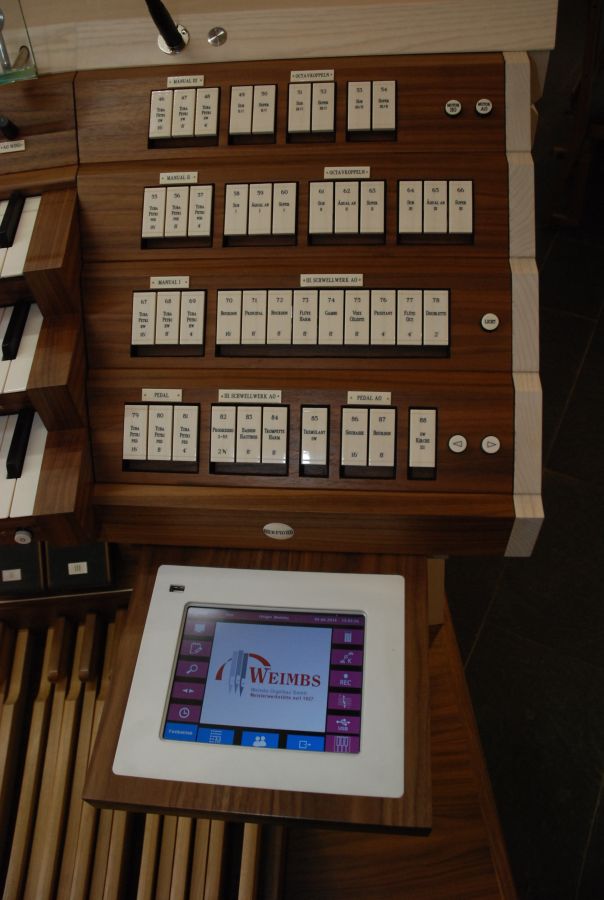
Zülpich St. Peter
In the course of a comprehensive reorganisation of the organ, a new electric console was designed. The task was to keep the console in its layout as simple as possible and therefore easily comprehensible and operable for anyone. For that reason the various functions, with very few exceptions, were made available via touch screen.
Freely programmable couplers or other special functions can be placed on 5 different rocker switches with a display that can be custom labled to make these functions also easily accessible during improvisations.
Here is a detailes description of the possibilities of the action system
Kyoto, Doshisha Junior / Senior High School
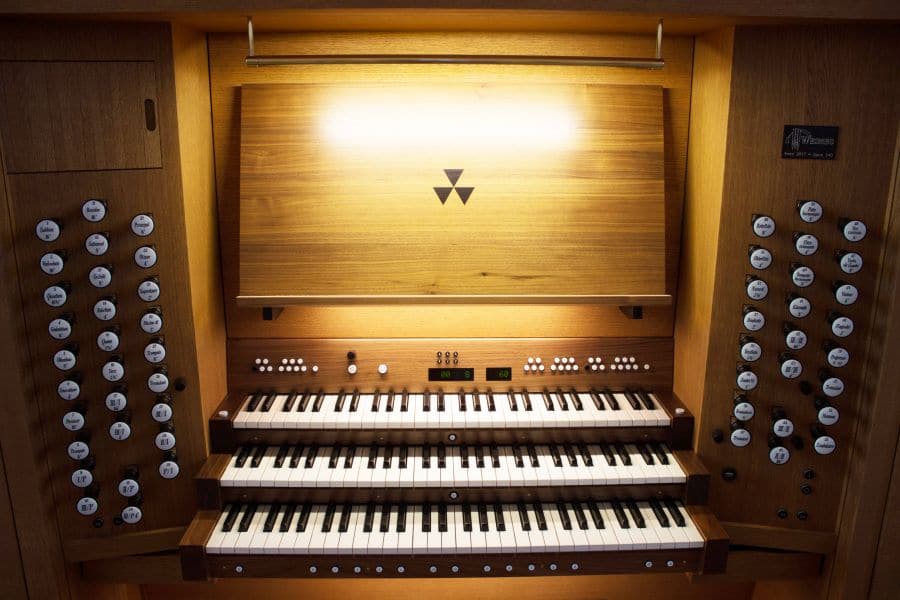
The organ in Kyoto is an instrument with mechanical key and electrical stop action. Nevertheless, it has two electrically controlled interval couplers (Manual III and Pedal). It is possible to select the intervals or any mixture constellation by means of a pushbutton row arranged in the form of a keyboard for reasons of easy access. This makes the application greatly useable during improvisations.
Also percussions such as a carillon or a marimba and other add-ons can be assigned to the manuals by means of a touch screen controlled action system. Additionally, there are further options such as a loop function or a wind mitigation controlled by a balanced lever pedal.
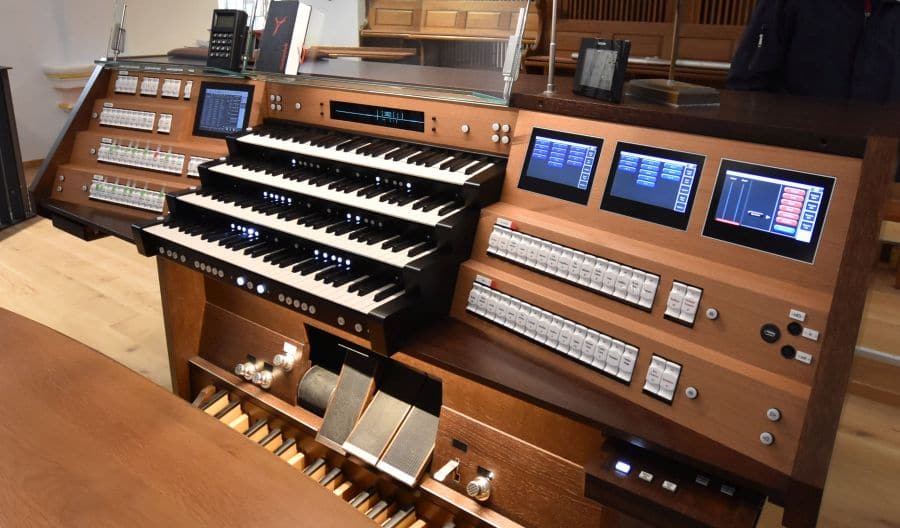
Bernkastel-Kues, St. Briktius
The console of the organ in Bernkastel-Kues, St. Briktius works with various touch screens, to have direct view and acces to numerous applications.