
Company History
600 years of organ building in the Eifel region
The employees of the Weimbs Orgelbau workshop sees themselves with a high degree of responsibility as the heirs of the organ building that has been operating for centuries in the Eifel region. Among the earliest secured information is that Peter Briesger of Koblenz in 1537 renewed the organ in the parish church Mayen.
From 1711 Balthasar König was resident in Bad Münstereifel as an organ builder before he moved his workshop to Cologne in 1735. Among his most magnificent works are the instruments restored by Weimbs Orgelbau in the basilica of the monastery Steinfeld and in the castle church Schleiden. Balthasar König was by no means a regional low light: he knew how to combine in his works French, Dutch and German style features in a particularly artistic way. – In 1735 König’s son-in-law Johann Odendahl took over the organ building in Münstereifel. He was succeeded by by his son-in-law, Peter Kemper, in about 1770.
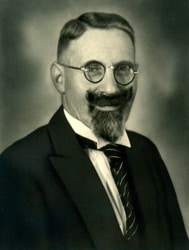
The company’s founder Josef Weimbs senior
Between 1802 and 1921, several generations of the Müller family in Reifferscheid (today a part of the borough of Hellenthal) ensured that organ building in the Eifel did not come to a standstill and created a stately oeuvre of more than 100 instruments. They covered the border area to Belgium, Luxembourg and the Netherlands as well as the areas around Cologne, Bonn and Aachen with their work The workshop Grundling in Reifferscheid had more the nature of an Intermezzo.
At the end of the 19th century, the father and brother of the founder of Weimbs Orgelbau, Josef Weimbs senior (1886-1949) worked already for Müller. He served his apprenticeship as an Organ Builder from 1900 to 1905 in this workshop and worked there until 1913 as a tuner and voicer. After military service and being a prisoner of war, Josef Weimbs appeared again as a foreman at the company Fabritius in Kaiserswerth. Weimbs Orgelbau is therefore the de facto successor to the Müller brothers.
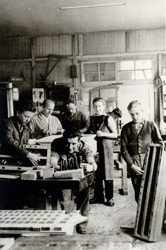
2. from left Josef Weimbs junior. On the right: Friedbert Weimbs
In 1927 Josef Weimbs founded his own workshop in Hellenthal. The first order was the new Organ for the local parish church, a stately instrument considering the hard times including an unusually revealing prospectus. A special feature of his organs are the well-developed devisions; especially the pedal devision is, contrary to the average, well developed. Despite the global economic crisis, Josef Weimbs soon succeeded in turning his workshop into an infulencial factory, renound far beyond the Eifel region.
In 1951 Josef Weimbs junior (1916-2005) took over the company. As it was the case before the war, the Organs built were with electric action in the fashion of the time.
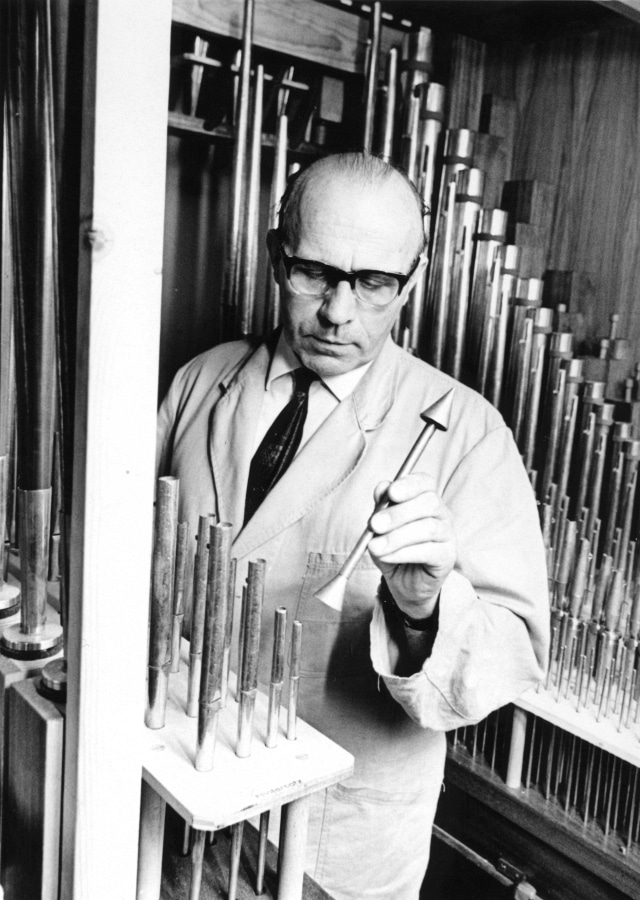
Josef Weimbs junior
1957 Josef Weimbs junior passed the examinations as master craftsman. His skills were particularly evident when it came to revive the classic artisan Organ Building in the 1960s and 1970s. Soon he equipped his instruments again with mechanical actions and dedicated himself to the restoration of historically significant organs with a view to preserve listed instruments. Contrary to the then dominant tendency to generously replace damaged historical substance, Josef Weimbs always considered changes carefully.
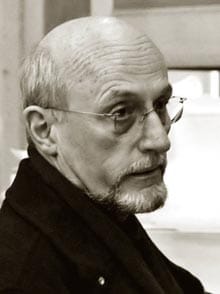
Friedbert Weimbs
copyright: Ruhl
After his son Friedbert Weimbs (* 1947) in 1973 had the master’s certificate in his pocket, he joined his father’s business. His work focuses on the fine art of developing pipe scales and intonation, the very essence of his craft he teaches with great dedication to the next generation. Under the direction of Friedbert Weimbs, the commercially more favorable approach of preparing the voicing of organ pipes in the workshop has replaced the practice of exclusively voicing on site. As a result, Weimbs organs are particularly well matched to the respective room situation.
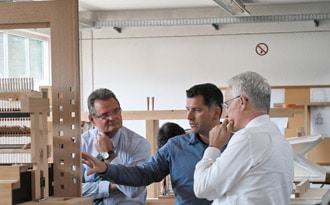
2000: Frank Weimbs (middle) at the visit of the former district administrator Günter Rosenke and the former Ministerpresident of NRW Dr. Jürgen Rüttgers
25 years later, his son Frank Weimbs completed his apprenticeship with the certificate of master craftsman and returned to his father’s business in 1998. Under his technical and commercial management, a new workshop building was aquired and an in-house metal casting shop was set up next to the pipe workshop. Among the most important new Organ buildings of the 4th generation in the Weimbs family are the Reger-Memorial-Organ in the protestant City church tin Weiden in the Upper Palatinate region and also the new organ in the well-known Marienkirche in Bergen (Norway). Meanwhile, the company is active worldwide and can look forward to many more orders, even from abroad.