
Action Systems—New Musical Possibilities for the Organ
An organ’s action is no longer merely the technical link between the key and the pipe. Modern, freely programmable action systems can become a musical tool in their own right. They expand an instrument’s sonic possibilities, open up new forms of voicing, and create previously unimaginable creative freedom—especially for improvisation.
In doing so, we do not develop a fixed system that is used in the same form for every organ. Like the instrument itself, the action system is individually designed and tailored to the specific stop layout, the existing windchest construction, and the musical preferences of the organists.
For us, the multitude of technical possibilities is not an end in itself. What matters most is that the functions are musically meaningful, reliable, and immediately usable while playing. Even a highly complex action system must remain easy to operate and must not distract the organist from the music.
Our action systems are continuously being refined. With every new instrument come new ideas and additional possibilities. Organists engage deeply with the systems, explore their potential, and use these insights to articulate new wishes and requirements. For us as organ builders, this means taking these musical ideas to heart and developing and crafting the right tools for musicians and composers alike to support their artistic work.
A Detailed Look at Various Action Systems
Düsseldorf-Eller, St. Gertrud – Wissen, Kreuzerhöhung
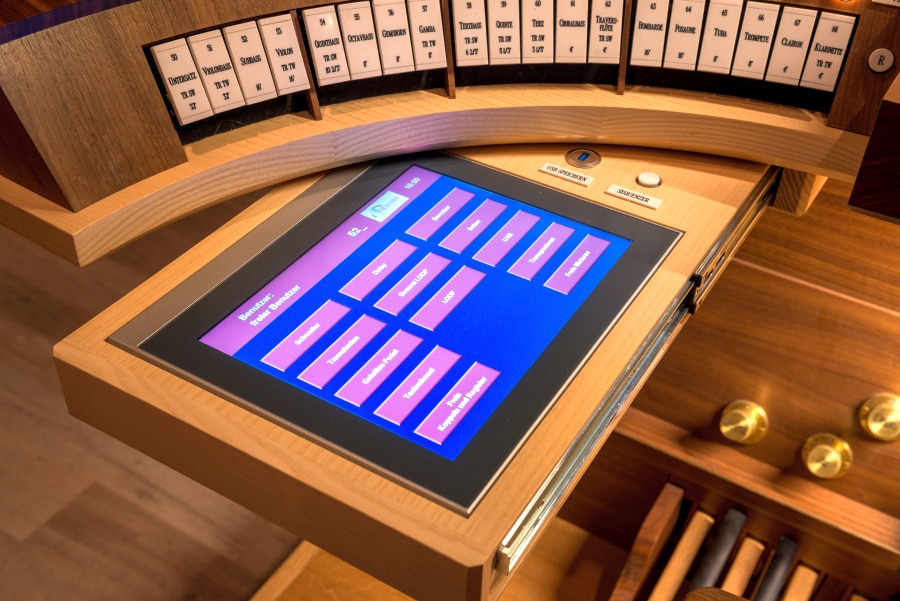
Freely Programmable Couplers
While traditional couplers link specific stops and pitches, the system we use allows for the programming of virtually any coupling structure. In addition to the standard normal, sub-, and super-octave couplers, this also enables freely defined interval and aliquot couplers.
For example, a played key can trigger not only the note of the same name on another section, but also a fifth, third, seventh, or any other freely chosen interval. The coupler is not limited to any specific historical or design specification but can be configured according to the musical concept at hand.
The so-called chord couplers go even further. Here, a played note triggers not just another single note, but a previously defined chord. The composition of this chord can be freely programmed and tailored to the respective improvisation. In this way, additional harmonic layers are created that can be incorporated directly and intuitively into the performance.
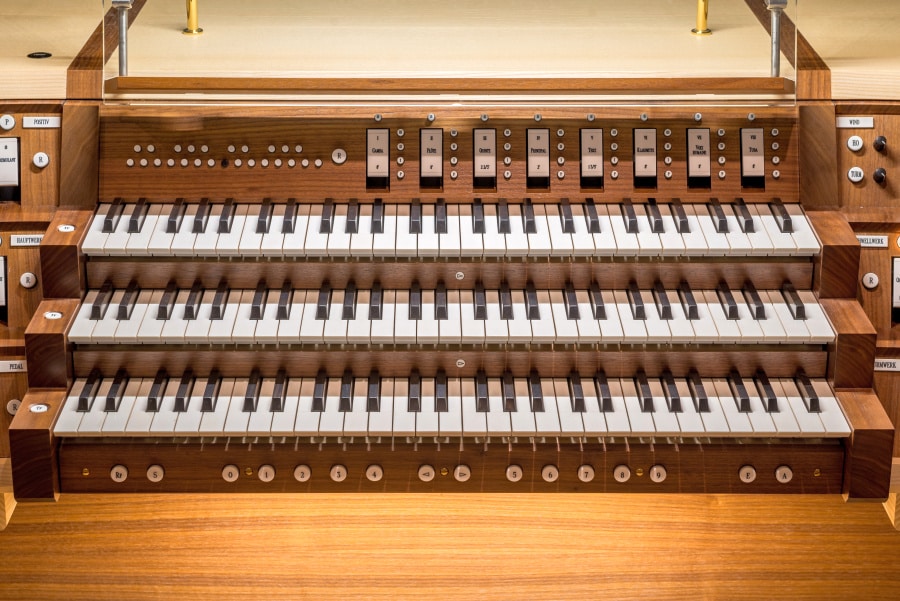
Mixture Setter
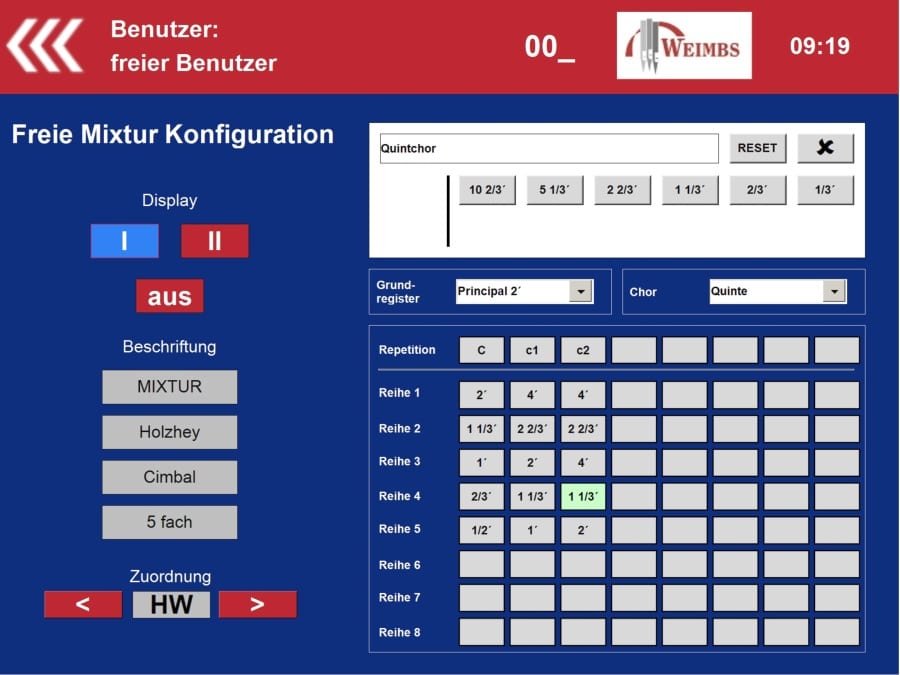
Another distinctive feature of the organs in Wissen and Düsseldorf-Eller is the specially developed mixture setter. Both instruments, of course, feature pre-set mixtures whose composition and repetition patterns are sonically tailored to the respective organ section.
In addition, the mixture selector allows the organist to create custom mixtures. This is made possible by single-note windchests, which allow the individual stops to be controlled independently of one another. The organist thus decides for themselves which pipe rows should be included in the desired mixture.
The repetition points can also be set individually. This allows the organist to determine at which points within the range a stop should drop back to a lower register. Not only the number and pitch of the choirs involved, but also the overall tonal structure of the mixture can thus be specifically shaped.
In this way, a wide variety of sound profiles can be created: from a deep, solemn mixture to a clearly defined sound crown, all the way to high-pitched, particularly brilliant, or deliberately experimental combinations. It is also possible to specifically recreate the structure of a mixture from a particular historical era or organ tradition.
The mixture composer thus transforms the mixture from a fixed stop into a variable musical tool. At the same time, the instrument’s standard mixtures remain unchanged and are available at any time in the form we have tuned them.
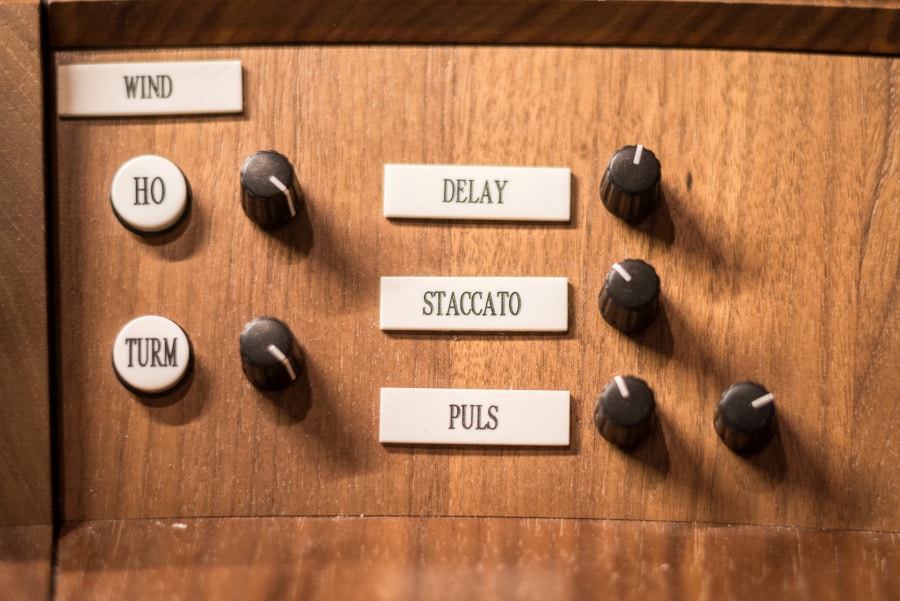
Key locks for holding selected notes, adjustable wind dampers for precisely controlling the wind supply, freely assignable divisions—so-called “floating divisions”—or a split pedal are now often standard features in sophisticated action systems.
These capabilities significantly expand the traditional range of playing techniques. Divisions or individual sound ranges can be played on different keyboards, regardless of their classical assignment. The pedal can be split at a freely chosen point and assigned different timbres. At the same time, wind throttles allow for direct control over the response and character of the organ sound. However, the action systems in Wissen and Düsseldorf-Eller go well beyond this.
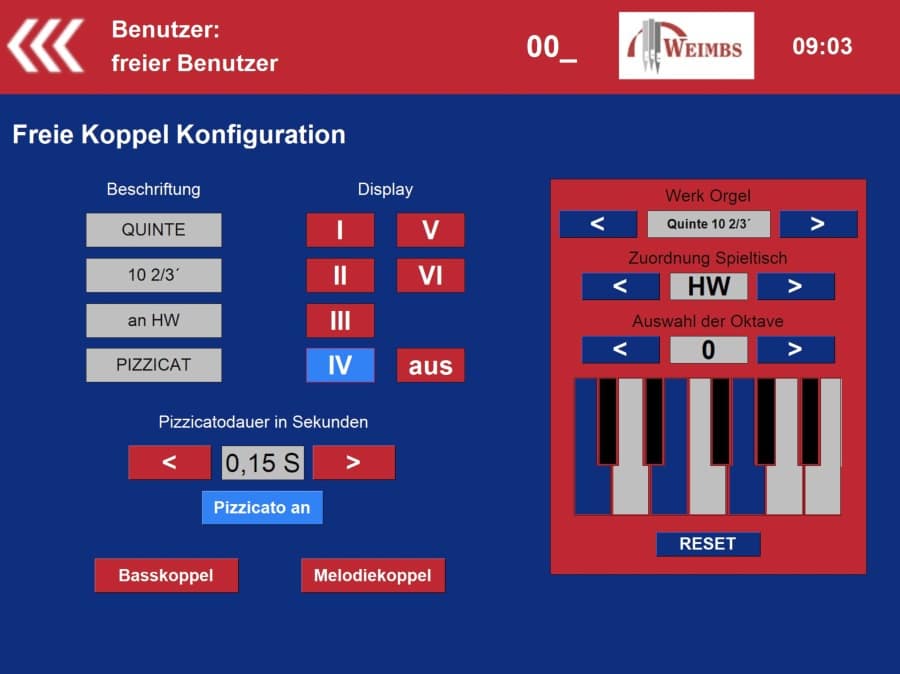
Independently Controllable Stops for Chord Couplers
For the chord couplers in Wissen and Düsseldorf-Eller, carefully selected stops were technically separated and additionally arranged above the III. manual. These stops can be programmed independently of their regular division assignments and then additively coupled to the desired manual division.
The organ’s normal stop configuration remains intact. The timbres controlled via the chord couplers are added as an additional layer. This allows, for example, sustained chords, harmonic soundscapes, or rhythmically and melodically structured accompaniment patterns to be created without having to change the actual stop configuration.
This technique opens up extraordinary possibilities, particularly for improvisation. The separately controllable stops can be recombined again and again, programmed differently, and assigned to a different section depending on the musical situation. The action system thus becomes a configurable component of the composition itself.
Loop Generator and Other Creative Features
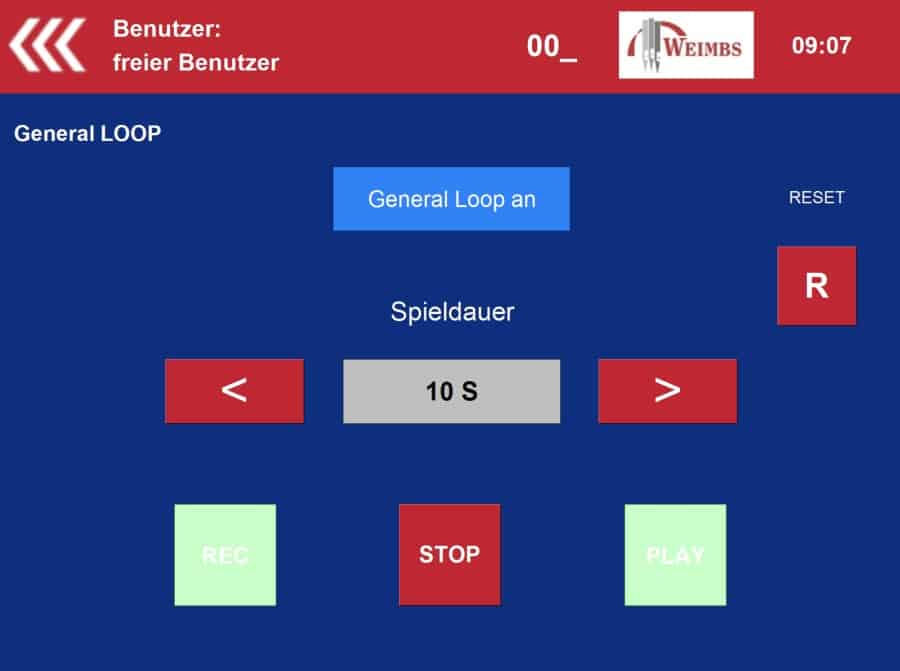
In addition, the acting system features a multitrack loop generator. It allows you to record short musical sequences, repeat them immediately, and layer them on top of one another across multiple independent tracks. This makes it possible, for example, to build rhythmic patterns, ostinatos, accompaniment patterns, or harmonic soundscapes and then incorporate them into your performance. The interface is deliberately designed to be intuitive, so that musical ideas can be realized spontaneously and the loop generator immediately invites experimentation and improvisation.
The “Pulse,” “Delay,” and “Staccato” functions offer additional creative possibilities. The “Puls” function converts sustained notes or chords into regularly recurring sound pulses. Depending on the setting, this creates slow, expansive movements or distinct rhythmic structures. In this way, a static sound can be set in motion and integrated into an improvisation as an independent rhythmic layer.
The Delay function triggers a note or a previously defined group of sounds with a time delay. This allows you to create echo effects, canon-like sequences, and multi-layered sound progressions. Especially when combined with different instruments, registers, or intervals, a single playing impulse can give rise to complex musical structures.
The Staccato function limits the duration of a triggered note regardless of how long the key is held down. This produces short, clearly distinct sound pulses. This function is particularly well-suited for rhythmic figures, recurring accompaniment patterns, and precisely articulated sound sequences.
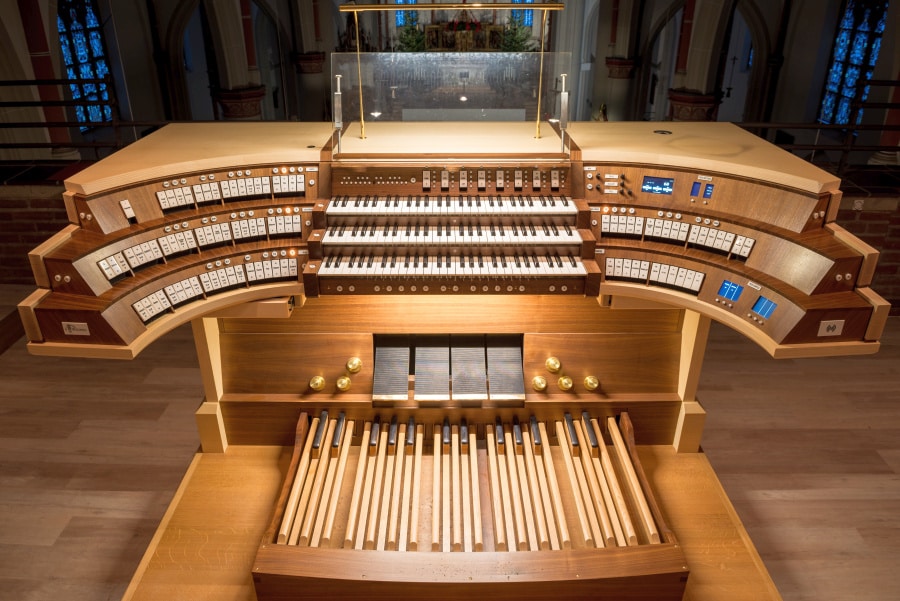
Zülpich, St. Peter
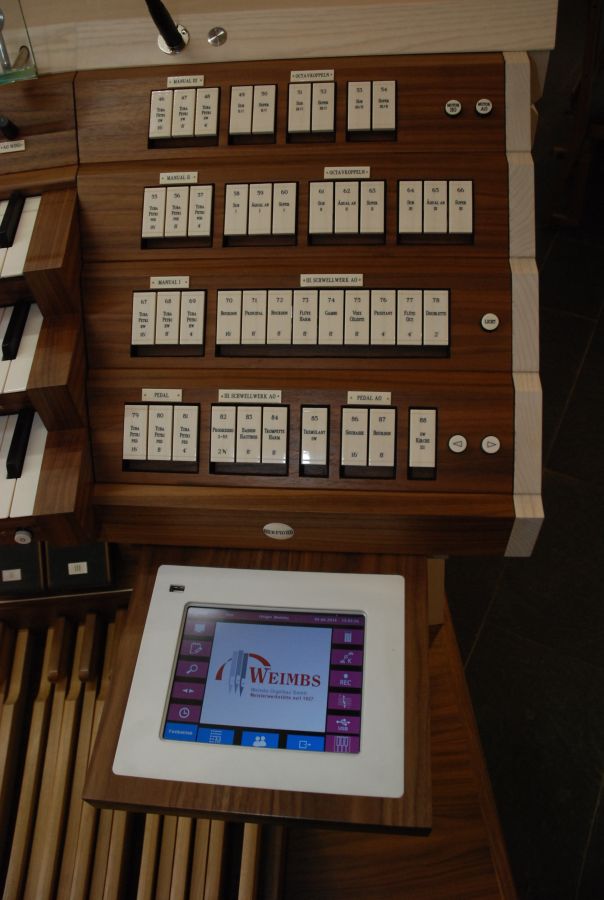
In the course of a comprehensive reorganisation of the organ, a new electric console was designed. The task was to keep the console in its layout as simple as possible and therefore easily comprehensible and operable for anyone. For that reason the various functions, with very few exceptions, were made available via touch screen.
Freely programmable couplers or other special functions can be placed on 5 different rocker switches with a display that can be custom labled to make these functions also easily accessible during improvisations.
Here is a detailes description of the possibilities of the action system
Kyoto, Doshisha Junior / Senior High School
The organ in Kyoto is an instrument with mechanical key and electrical stop action. Nevertheless, it has two electrically controlled interval couplers (Manual III and Pedal). It is possible to select the intervals or any mixture constellation by means of a pushbutton row arranged in the form of a keyboard for reasons of easy access. This makes the application greatly useable during improvisations.
Also percussions such as a carillon or a marimba and other add-ons can be assigned to the manuals by means of a touch screen controlled action system. Additionally, there are further options such as a loop function or a wind mitigation controlled by a balanced lever pedal.
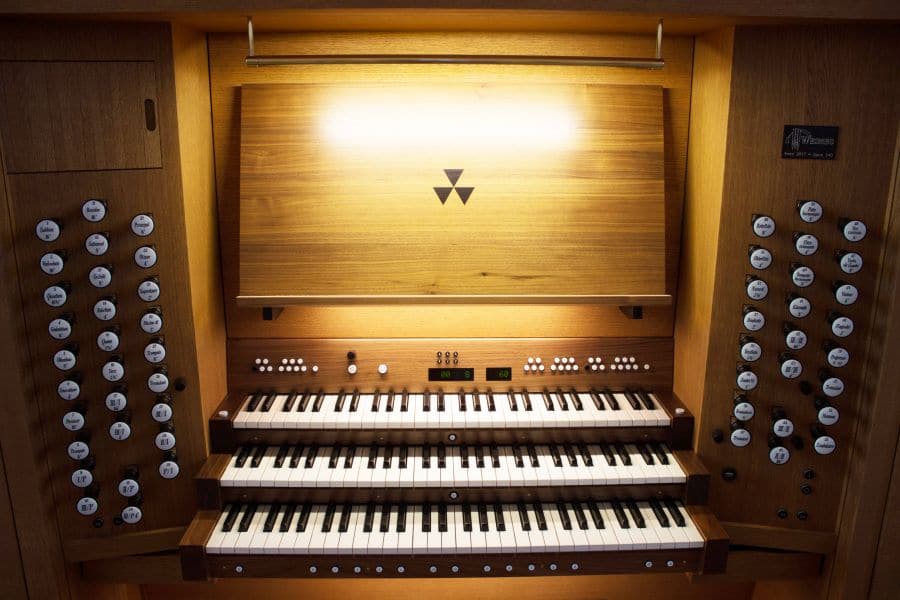
Bernkastel-Kues, St. Briktius
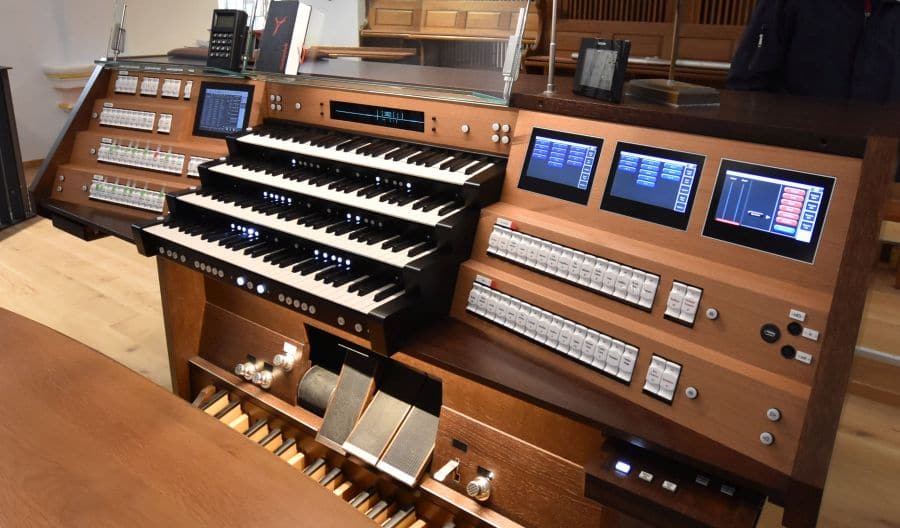
Bernkastel-Kues, St. Briktius
The console of the organ in Bernkastel-Kues, St. Briktius works with various touch screens, to have direct view and acces to numerous applications.