
— Restoration of the Organ by Gebrüder Rieger, Jägerndorf (Czechia) —

To this day, St. Blaise holds a very special place in the hearts of the people of Dubrovnik. As the patron saint of the historic city, he is honored every year with solemn processions, waving flags, and festive ceremonies.
February 3, the feast day of St. Blaise, has been celebrated in Dubrovnik for more than a thousand years and is one of the city’s most important traditions.
According to legend, St. Blaise saved Dubrovnik from a Venetian attack in the year 971. On the night before February 3, Venetian warships anchored off the mighty city walls. Under the pretext of needing supplies for their onward journey to the East, Venetian sailors entered the Old Town. But their true plan was different: they wanted to conquer Dubrovnik and incorporate it into the Venetian Empire.
Spies in disguise secretly observed the city’s defenses, counted the guards, and assessed Dubrovnik’s military strength. What they did not know, however, was that they, too, were being watched.
On the evening of February 3, a priest made his way through the narrow, cobblestone alleys of the Old Town toward St. Stephen’s Church. Upon arriving, he was surprised to find the church door open. As he entered, an old man appeared before him dressed in bishop’s robes—wearing a miter and carrying a crosier. “Warn the city fathers. The Venetians are planning an attack,” the stranger spoke from the darkness. The frightened priest asked for his name. The reply was: “Blaise.”
The priest immediately recognized the gravity of the situation and promptly informed the city authorities. That very night, the guards were reinforced, the city gates were closed, and defenses were prepared. The Venetians quickly realized that their plan had been discovered and that the surprise attack had failed. They retreated and left Dubrovnik as quickly as they had come.
The city was saved.
Since then, St. Blaise has been regarded as the patron saint of Dubrovnik and a symbol of freedom and independence. In 1026, the saint’s relics were finally brought to Dubrovnik—the city that still owes its freedom to him today.

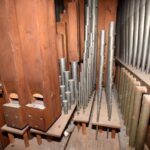
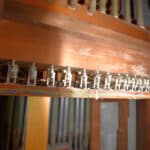
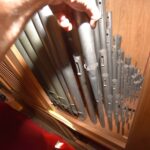
The organ, built by Gebrüder Rieger of Jägerndorf at the beginning of the 20th century, bears the opus number 1242. It has 13 stops, distributed across two manuals and a pedal. The windchests are of the electropneumatic cone-type.
The pedal and the Main are located on the organ loft. The Positive is housed in a separate organ case added later and is positioned behind the altar along with the console.

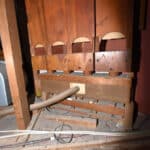
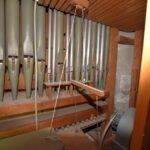
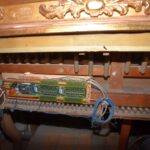
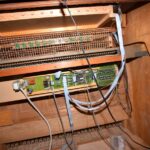
The entire organ is heavily soiled and requires thorough cleaning. The key and stop action mechanisms are also not functioning properly at present and will undergo a comprehensive overhaul.
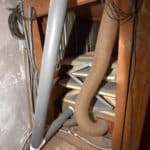
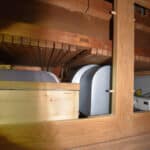
The double-fold bellows have been provisionally sealed in several places and therefore require extensive restoration. Some wind ducts currently consist of flexible ducts, which will be replaced with professionally crafted wooden ducts during the course of the work.
In terms of sound, the instrument is currently unbalanced and will therefore be completely revoiced. To further expand the organ’s musical capabilities, the II. Manual will be supplemented with an Oboe 8’.
Completion of the project is scheduled for 2027.


A commemorative photo of the ceremonial signing of the agreement
From left to right: Mr. Ante Kneṧaurek – Ms. Perica Milković – Mr. Maro Kapović –
Priest Ivica Pervan, Vicar General and Rector of St. Blasius Church – Mr. Frank Weimbs – Ms. Božena Popić Kurtela
some impressions from the construction phase