
— New organ with re-use of the historic organ case —
 The church St. Michael is located on the banks of the Mosel river and was once surrounded by a churchyard. It is the only building in the Mosel region that has been preserved in a uniform 14th century style.
The core of the church building – the two-bay central nave with the two side aisles and the choir – was built in the 2nd half of the 14th century in the late Gothic style. In 1664/65, the choir was given an eight-sided ridge turret with open arches and a curved dome; it is known as the Ave Maria tower.
In the 17th century, the church received several large extensions: the Kneip chapel was added to the north side of the choir, the sacristy was extended to the east behind the high altar and the nave was extended to the west by a bay for the organ loft and given a baroque façade on the outside. This baroque façade was uncovered and restored in 1968. In addition, the former main portal was given a chapel-shaped porch, the outer wall of which is decorated with a mosaic Christ in the Winepress by Werner Persy from Trier.
St. Michael’s Tower
The mighty, rectangular tower is the town’s landmark. It resembles a defensive tower and apparently served as such, as the town wall ran past it. The tower stands at an angle to the church and was originally free-standing. It was built in the Romanesque style at the beginning of the 14th century in connection with the town fortifications.
Interior
The interior of St. Michael’s resembles a pseudo-basilica. The nave, without the extension of one bay for the organ gallery, has an almost square floor plan with two square bays in the nave and two side aisles of unequal width. Wide, sweeping cross ribs and pointed arched arcades rest on short columns without capitals. The clerestory, which is only lit on one side (these windows were broken in later), is very low and looks somewhat strange.
The architecture with cross-ribbed vaulting conveys a hall-like impression of space. The southern aisle is very narrow.
The layout is reminiscent of 15th century church buildings in Klausen, St. Gangolf and St. Antonius in Trier, where the south aisle is missing completely. The choir with one bay closes on five sides and, like the nave, is wide and low.
Organ
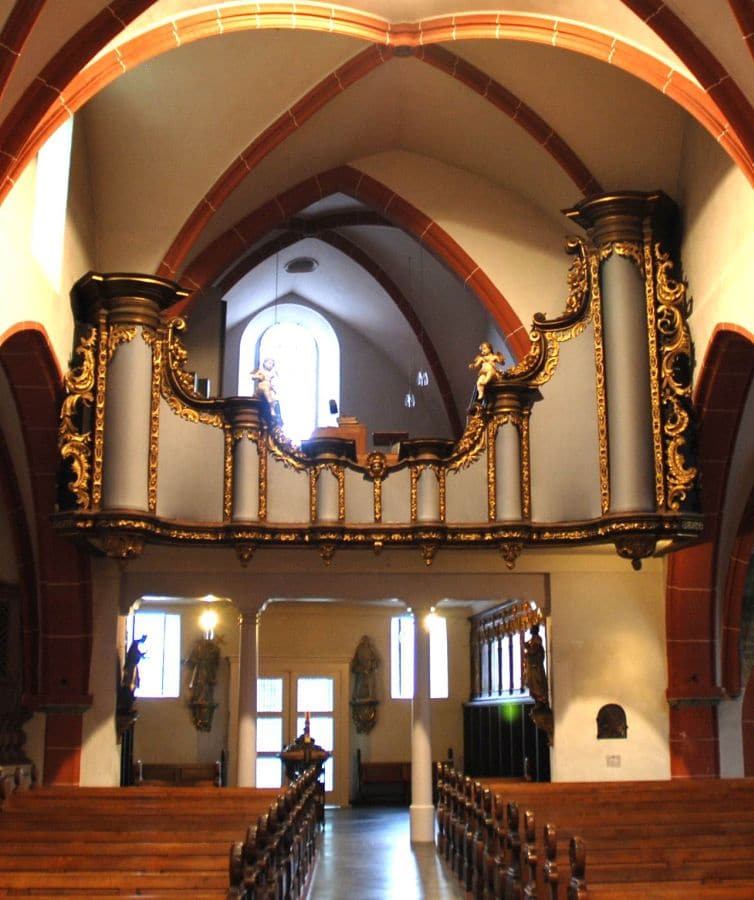
An organ was first mentioned in the “Schöffenbuch” in 1673. It was located on the gospel side of the choir. The main part of the historic organ case on the west gallery, which still exists today, was built by organ builder Johann Bernhard Nollet from Orval. This organ was played for the first time on May 16, 1745. It was a two-manual instrument with a Positiv (middle façade fields), Main (divided, laterally adjoining) and (probably) attached Pedal. Neither the specification nor the number of stops have been recorded.
By decision of the church council on October 3, 1884, the organ was demolished at the end of 1885 and rebuilt with a modified specification by Heinrich Voltmann from Klausen using old pipes from 1744. Voltmann placed the Positiv and parts of the Pedal in a separate case on the north side of the organ loft.
As a result of the war damage to the organ, a new organ was built in 1955 by Hans Gerd Klais from Bonn, reusing existing pipe material and windchests. However, in order to accommodate the 16′ pipes of the pedal, the tower on the Gospel side was raised and the neighboring intermediate bay was altered accordingly, resulting in an asymmetrical baroque organ front. The gallery was lowered by about one meter. Prof. Hermann Schroeder played the first organ concert on this organ on November 27, 1955. In the 1990s, the organ repeatedly showed major defects. In the course of extensive renovation work in the interior, it was decided in 1999 to remove a large part of the pipework from the parapet case and store it. Unfortunately, it was no longer financially possible to tackle the restoration of the organ after the completion of the church renovation work. Since then, the organist has had to make do with the nine stops in the Schwellwerk.
In 2000, we were asked to prepare an initial offer for the restoration/renovation of the organ system. As the spatial conditions were very difficult, many planning discussions were held and many ideas were discussed. One of the main results of the limited space was the decision to use purely electric tracker and stop actions with a Mordener action system.
We are now pleased to announce that the Weimbs company has been awarded the contract to build a new organ using the historic organ case and parts of the historic pipework.
A three-manual concept is planned, which basically preserves the historic organ case, but also includes the desired musical innovations. For example, the Pedal and Main will be housed in the historic parapet case on a windchest that is pushed through, as well as the Positiv. For the third manual, a Swell with single note control is built in a separate Swellcase. Each of the main stops (flutes, principals, strings, aliquots and reeds) are removed depending on their use, thus creating the possibility of generating several stops from the respective row of pipes. This concept takes into account the currently increasing demands of organists and is the result of a fundamental change of direction and adaptation to the musical requirements that have changed in the meantime. The musical possibilities of such an instrument are thus considerably extended and a much wider field of activity is also achieved in the concert field. This concept is the result of many discussions and considerations and fulfills the technical and musical requirements of a modern organ, whereby the liturgical tasks retain their priority.


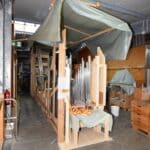
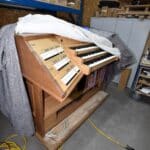
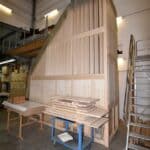
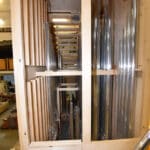
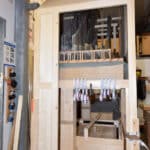
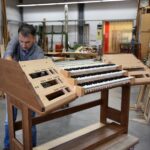
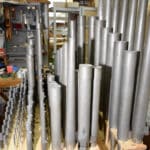
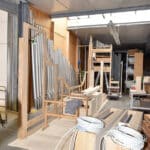
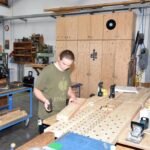
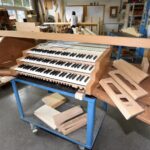
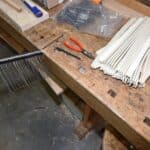
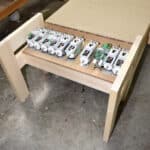
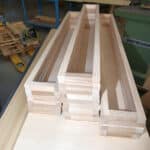
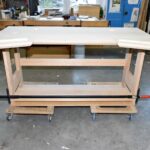
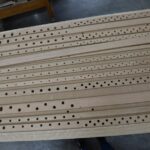
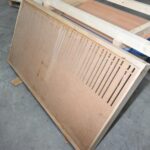
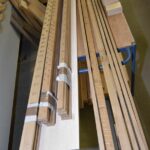
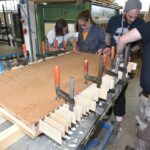
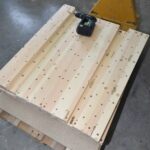
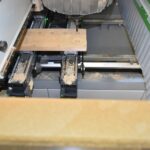
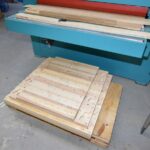
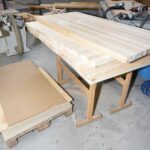
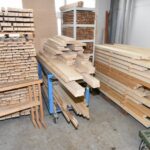
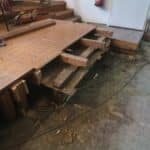
some impressions from the construction of the organ